
South Korea's draft crypto law caps exchange owners at 20%
South Korea's Financial Services Commission (FSC) on Nov. 24 unveiled a government draft of the Act on Innovation in the Digital Asset Industry and User Protection. It would split crypto businesses into separate licences, let bank-led groups issue won stablecoins, reopen domestic token sales and cap any single owner of an exchange at 20%.
All news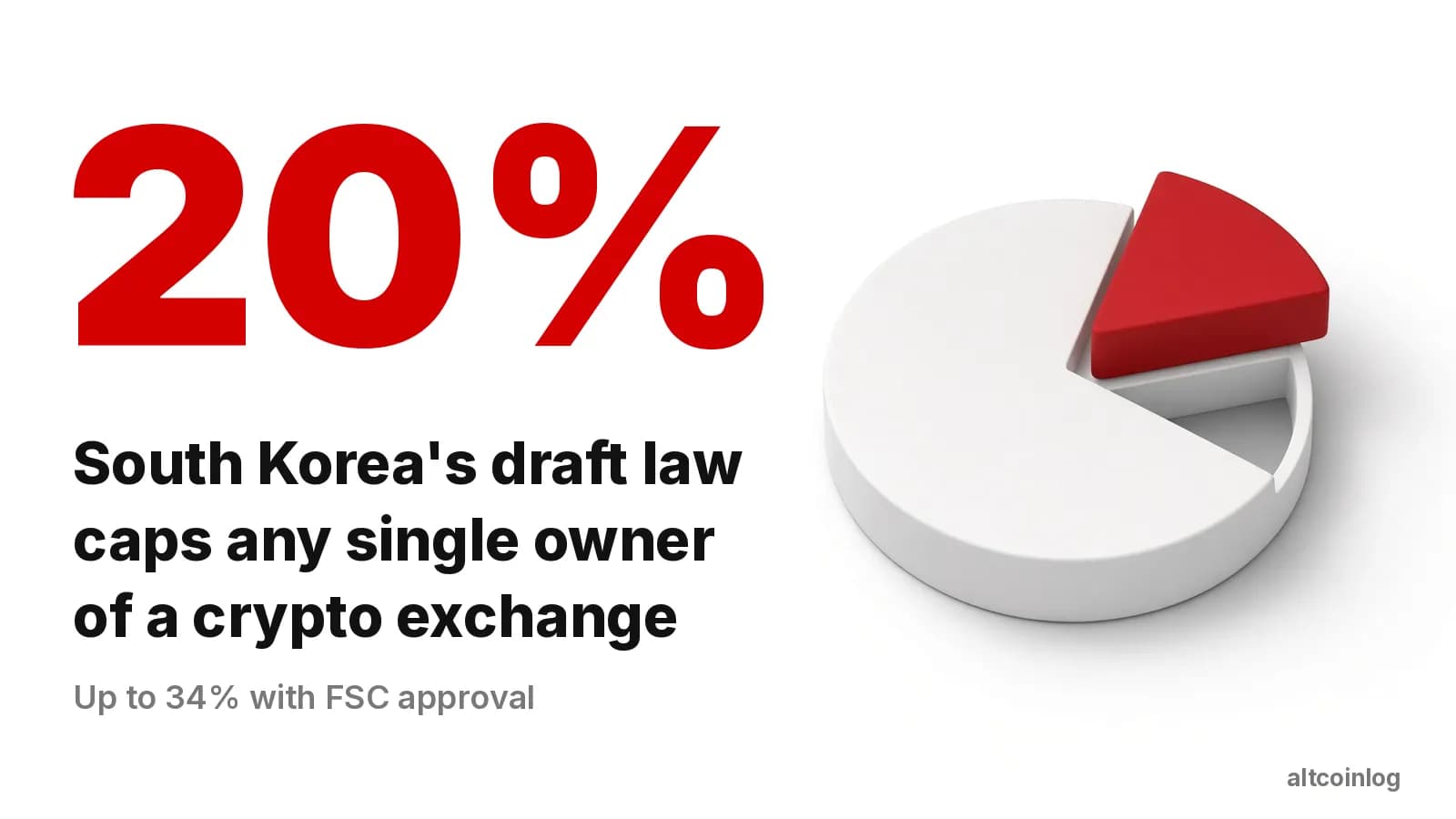
 Polly PhelonyAuthor · Investing
 Editor-in-ChiefEditor · checked this story
Published November 24, 2026 at 04:37 PMUpdated November 24, 2026 at 04:37 PM
South Korea's Financial Services Commission (FSC) on Nov. 24 unveiled a government draft of the Act on Innovation in the Digital Asset Industry and User Protection. It would split crypto businesses into separate licences, let bank-led groups issue won stablecoins, reopen domestic token sales and cap any single owner of an exchange at 20%.
FSC Chairman Lee Eog-weon presented the bill at a Virtual Asset Committee meeting in Seoul, according to the fsc.go.kr press release. It is not law yet. The government still has to take it through the National Assembly, and Lee said the government would work to get it passed quickly.
Until now Korean crypto rules sat in two laws: one on reporting and anti-money laundering, and the 2024 user protection act. Both focused on preventing harm. The FSC says that left a market locked around a few exchanges and retail traders, a backdrop that also shaped South Korea's delayed crypto tax.
Four licences instead of one
The draft replaces the single "virtual asset service provider" registration with four business types: dealing, brokerage, custody and asset management. Dealing, brokerage and custody need full authorization and equity of at least KRW 2 billion, or KRW 1 billion for firms handling only stablecoins. Asset managers, which do not hold client assets, only register and need KRW 500 million.
An exchange becomes a "digital asset platform operator," a status the FSC can grant only to a firm holding all three authorizations. Listing, order matching and market surveillance, now run under industry self-regulation, would move under formal rules. Firms must keep client assets segregated and shielded from creditors.
Stablecoins get their own category, "digital payment tokens." An issuer needs FSC authorization and at least KRW 5 billion in equity, must issue at par, cannot pay holders interest and must park at least 100% of outstanding tokens with banks or similar reserve custodians. At first only consortiums in which banks hold a majority will qualify, although a fintech or tech firm may be the largest single shareholder, Lee said in his opening remarks.
Domestic token sales (ICOs), which Korean policy has kept off limits, would be allowed once a project files a "digital asset white paper" with the FSC. The filing must cover the project, the amount issued, the use of funds and the risks, similar to a securities registration statement.
Who the 20% cap hits
The ownership limit mirrors the rule for alternative trading systems in Korea's stock market. Shareholders could hold up to 34% with FSC approval, and shares above the cap would lose voting rights. Exchanges get three years after designation to comply, and smaller venues can get up to three more.
The FSC named no companies. The Korea Herald reported that Mirae Asset Consulting owns 97.15% of Digital X, formerly Korbit, and would have to cut that holding by 77.15 percentage points under the 20% cap, or by 63.15 points even with the 34% exception. The paper also raised the question of how the cap would treat Naver Financial's planned share-swap takeover of Dunamu, the operator of Upbit, which is still under antitrust review. Bithumb has also dealt with a separate compliance case, the FIU's proposed suspension of Bithumb in March over anti-money laundering failures.
The bill also makes operators liable to users for losses from hacks and system outages even without fault. If a breach follows a failure to meet IT security duties, the FSC could impose a punitive fine of up to 10% of the firm's revenue.
This story is for information only and is not investment advice. Crypto assets are volatile and you can lose everything you put in. You decide on any trade yourself. Disclosure
Comments0
Comments are moderated. Ads, insults, and trading calls are removed. Discussion rules
No comments yet
Be the first — the author reads the thread and answers questions.