
South Korea's Crypto Tax Delay by the Numbers: 22%, Three Postponements and a 2029 Target
South Korea's presidential office is leaning toward pushing its 22% crypto income tax back again, most likely to 2029. These are the figures behind what would be a fourth postponement.
All news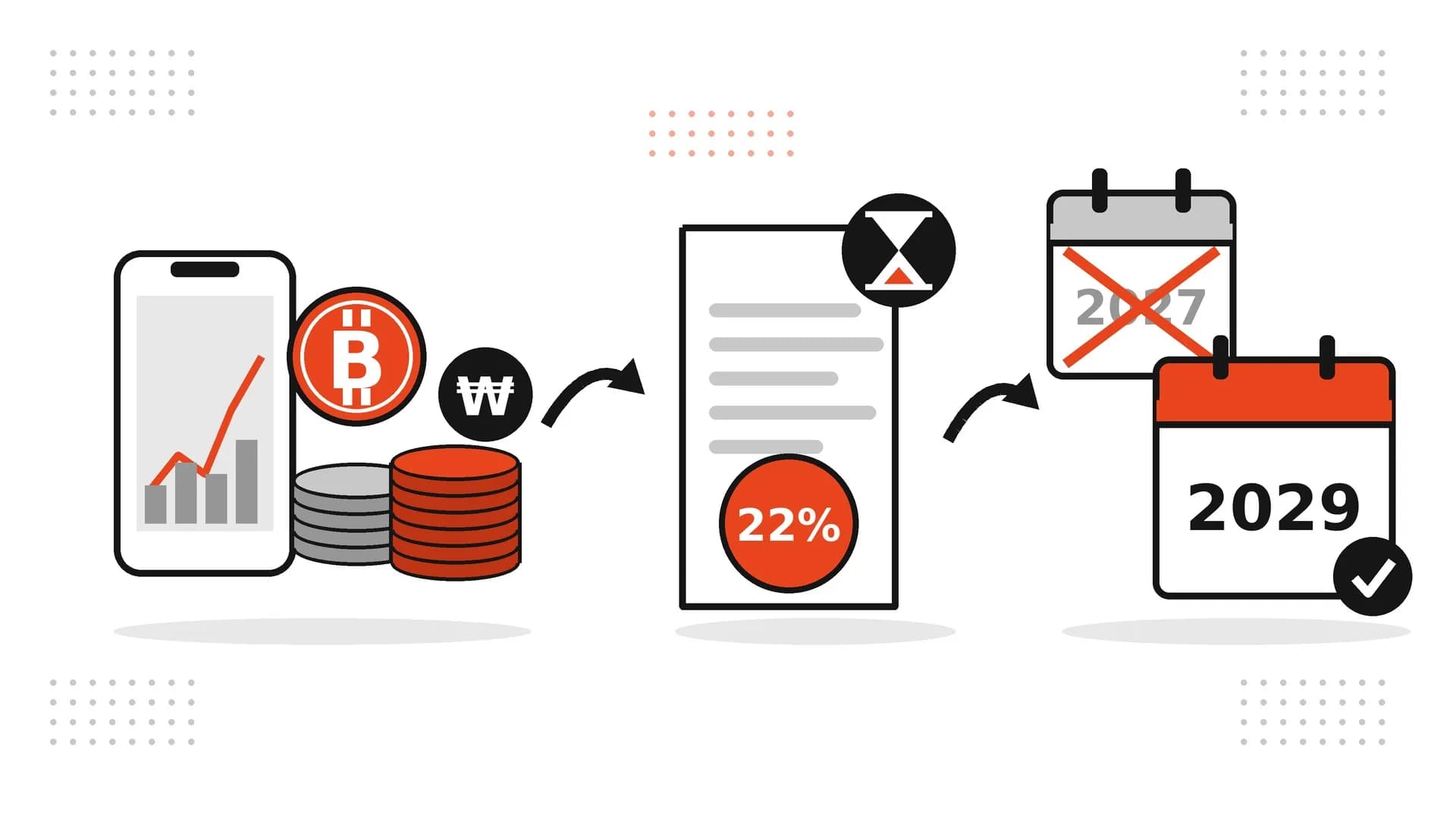
 Polly PhelonyAuthor · Investing
 Editor-in-ChiefEditor · checked this story
Published October 27, 2026 at 05:40 AMUpdated November 2, 2026 at 06:29 AM
South Korea is edging toward yet another postponement of its crypto income tax. On Sunday, a presidential office official told the Seoul Economic Daily that "the discussion has moved toward delaying implementation of the crypto tax." The office later said nothing had been decided, but with both major parties pushing the same way, the January 2027 start looks shaky.
22%. The combined rate, 20% national income tax plus 2% local income tax, that would apply to annual gains from selling or lending virtual assets. Only profits above a basic deduction of 2.5 million won, about $1,890, would be taxed.
3 delays in 6 years. The levy was written into the Income Tax Act in December 2020 for a 2022 launch. It was then pushed to 2023, 2025 and 2027.
2029. The likely new start date. An Oct. 16 bill from Democratic Party lawmaker Park Min-gyu would start the tax two years after Korea's first data exchange under the OECD's Crypto-Asset Reporting Framework (CARF), which is due in 2027. The opposition People Power Party also wants a delay, and the Seoul Economic Daily expects the law to be amended during the National Assembly's tax review in November.
Why the numbers point to a delay
2027, 2028, 2029. The CARF calendar is the core argument. Korea starts exchanging data in 2027, Singapore and the UAE in 2028, and the United States only in 2029, according to The Korea Herald. Until then, officials fear, the tax would fall mostly on users of domestic exchanges.
0. The number of major exchanges that have finished building their tax-reporting systems, according to exchange data cited by the Herald. Access to records is uneven too: one platform offers transaction histories back to 2019, while another caps them at one year and 15,000 entries.
57.5%. The drop in average daily trading volume on Korea's crypto market, from 7.3 trillion won ($5.51 billion) in the second half of 2024 to 3.1 trillion won in the first half of 2026, The Herald Business reported.
50,000+. Signatures on each of two petitions, filed in May and August, to delay or scrap the tax. People in their 30s have been the most active age group on exchanges every year since 2023.
5 years. The loss carryforward that the now-abolished financial investment income tax on stocks would have allowed. The crypto tax allows none, as gains and losses can only be netted within a single year.
Nothing is final until lawmakers amend the act. Until then, Jan. 1, 2027 remains the legal start date, and Democratic Party leader Kim Min-seok has said the issue needs to be settled this year.
This story is for information only and is not investment advice. Crypto assets are volatile and you can lose everything you put in. You decide on any trade yourself. Disclosure
Comments0
Comments are moderated. Ads, insults, and trading calls are removed. Discussion rules
No comments yet
Be the first — the author reads the thread and answers questions.