
COLDCARD seeds ran on a software RNG for five years, Coinkite says
Coinkite published an 18-page postmortem on Nov. 23 saying its COLDCARD hardware wallets generated wallet seeds with MicroPython's Yasmarang software pseudo-random number generator, not the device's STM32 hardware RNG, from March 29, 2021 through July 30, 2026. Attackers regenerated affected private keys offline and began stealing bitcoin on July 29.
All news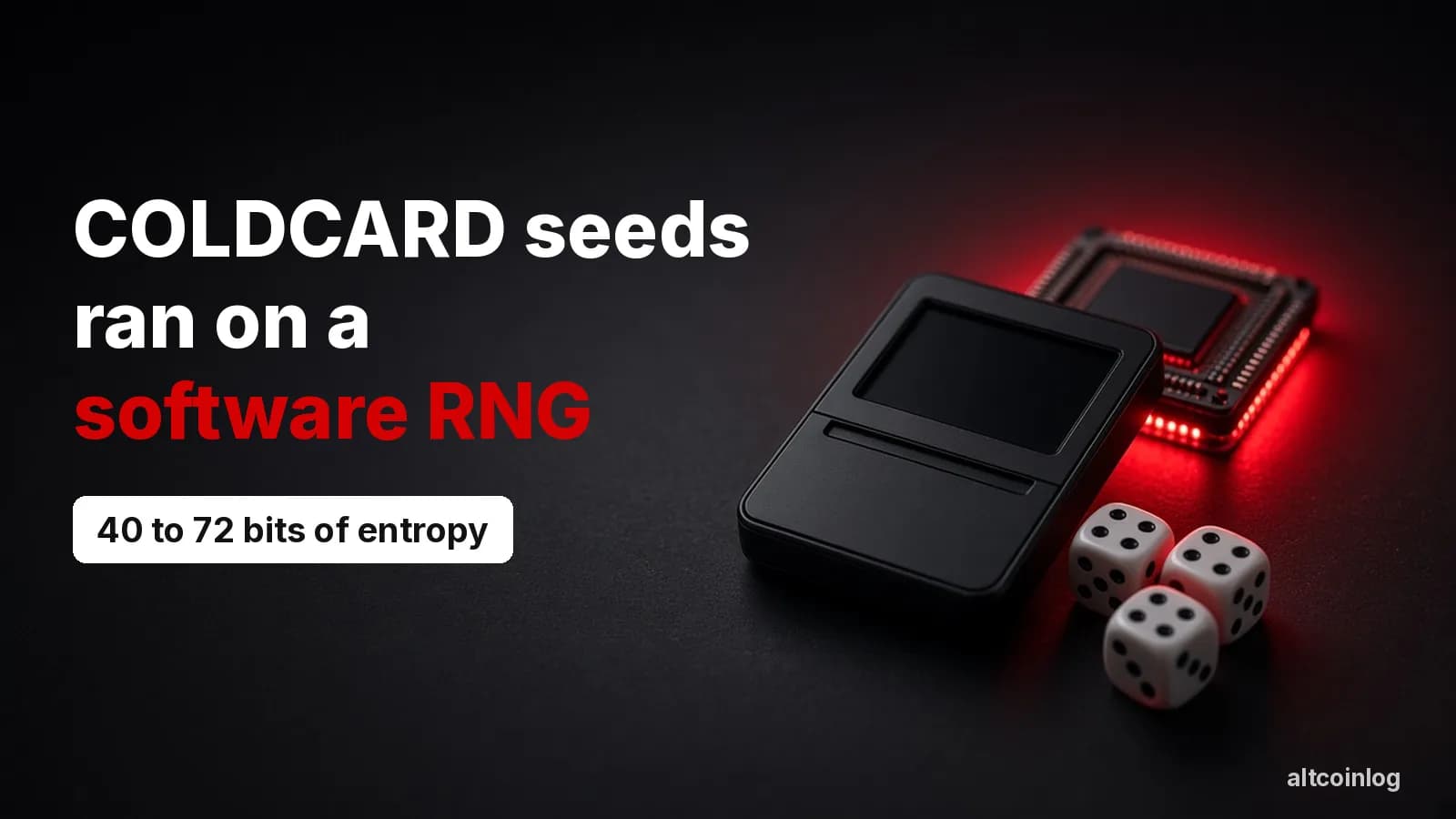
 Samuel EdymeAuthor · Blockchain
 Editor-in-ChiefEditor · checked this story
Published November 25, 2026 at 08:24 AMUpdated November 25, 2026 at 08:28 AM
Coinkite published an 18-page postmortem on Nov. 23 saying its COLDCARD hardware wallets generated wallet seeds with MicroPython's Yasmarang software pseudo-random number generator, not the device's STM32 hardware RNG, from March 29, 2021 through July 30, 2026. Attackers regenerated affected private keys offline and began stealing bitcoin on July 29.
The postmortem on blog.coinkite.com puts the effective entropy of affected seeds at roughly 40 bits for Mk2 and Mk3 and about 72 bits for Mk4, Mk5 and Q, against an intended 128-bit target. Coinkite calls both figures internal estimates.
How a build setting swapped the random number source
The chain was short. COLDCARD's firmware configuration set MICROPY_HW_ENABLE_RNG to zero, a guard in the pinned libNgU library failed to reject that, and the rng_get() function resolved to MicroPython's general-purpose generator. Both generators exposed a compatible interface, so the firmware built normally, the device reported no error and the seed words looked well formed.
Hashing the output did not help. In Coinkite's words, it "changed its form but could not add entropy that was not there." By our arithmetic, 40 bits is about 1.1 trillion possible seeds and 72 bits about 4.7 sextillion, while 128 bits is roughly 3.4 x 10^38. The smaller spaces are within reach of offline brute force, which is why the thieves never needed a device. Coinkite says physical security layers, libsecp256k1 and transaction authorization were not involved.
The defect survived at least 15 documented review efforts, the report says, including a June 17, 2026 firmware review by Nick Farrow that explicitly covered weak RNG and an AI-assisted review from May 1 to June 26 that produced 85 candidate findings. Release checks confirmed the hardware RNG code was present in the firmware, not that seed generation actually reached it.
Unlike Keystone's stolen device authentication key or a reported implant in a Trezor Safe 5, nothing here touched the hardware or the supply chain. The weakness sat inside the seeds themselves.
Galaxy Research reported on galaxy.com on Aug. 14 that 1,778.84 BTC had been stolen from more than 8,600 addresses, based partly on direct contact with 190 victims. Coinkite's own count as of Nov. 18 is about 300 loss-related support tickets from 242 accounts, roughly 0.21% of its estimated user base, and it says the true number is likely higher. Its announcement post gives 236 accounts.
Why a firmware update does not fix an old seed
Fixed firmware shipped on July 31. Current standard releases are 5.6.3 for Mk4 and Mk5 and 1.5.3Q for Q, according to the security status page on coldcard.com. Affected seeds were created on Mk2/Mk3 firmware 4.0.1 through 4.1.9, Mk4/Mk5 standard before 5.6.0, Q standard before 1.5.0Q, and Edge builds before 6.6.0X or 6.6.0QX.
A seed made on that firmware stays weak after it is restored, imported, backed up or cloned. Coinkite tells owners to install verified firmware, create a new seed, check its backup and move funds, passphrase wallets included. The one exception is a seed built from at least 50 fair, private dice rolls entered through Add Dice Rolls, using the final post-roll words. New seeds on current firmware must now mix device entropy with user input: 65 key presses with unpredictable timing, 50 die rolls or 128 coin flips.
Who found the flaw is still unknown, and law enforcement is investigating the thefts. Coinkite notes that the full weights of the Kimi K3 model were released on July 27, two days before the first thefts, and calls AI-assisted discovery a plausible hypothesis, not an attribution.
This story is for information only and is not investment advice. Crypto assets are volatile and you can lose everything you put in. You decide on any trade yourself. Disclosure
Comments0
Comments are moderated. Ads, insults, and trading calls are removed. Discussion rules
No comments yet
Be the first — the author reads the thread and answers questions.