
Visa CLI lets AI agents earn and spend OUSD after a Visa card check
Visa Crypto Labs released a new version of Visa CLI on Nov. 22, turning it into a wallet where a person verifies an AI agent with a Visa card and the agent then earns and spends OUSD, a dollar stablecoin, on the Tempo blockchain.
All news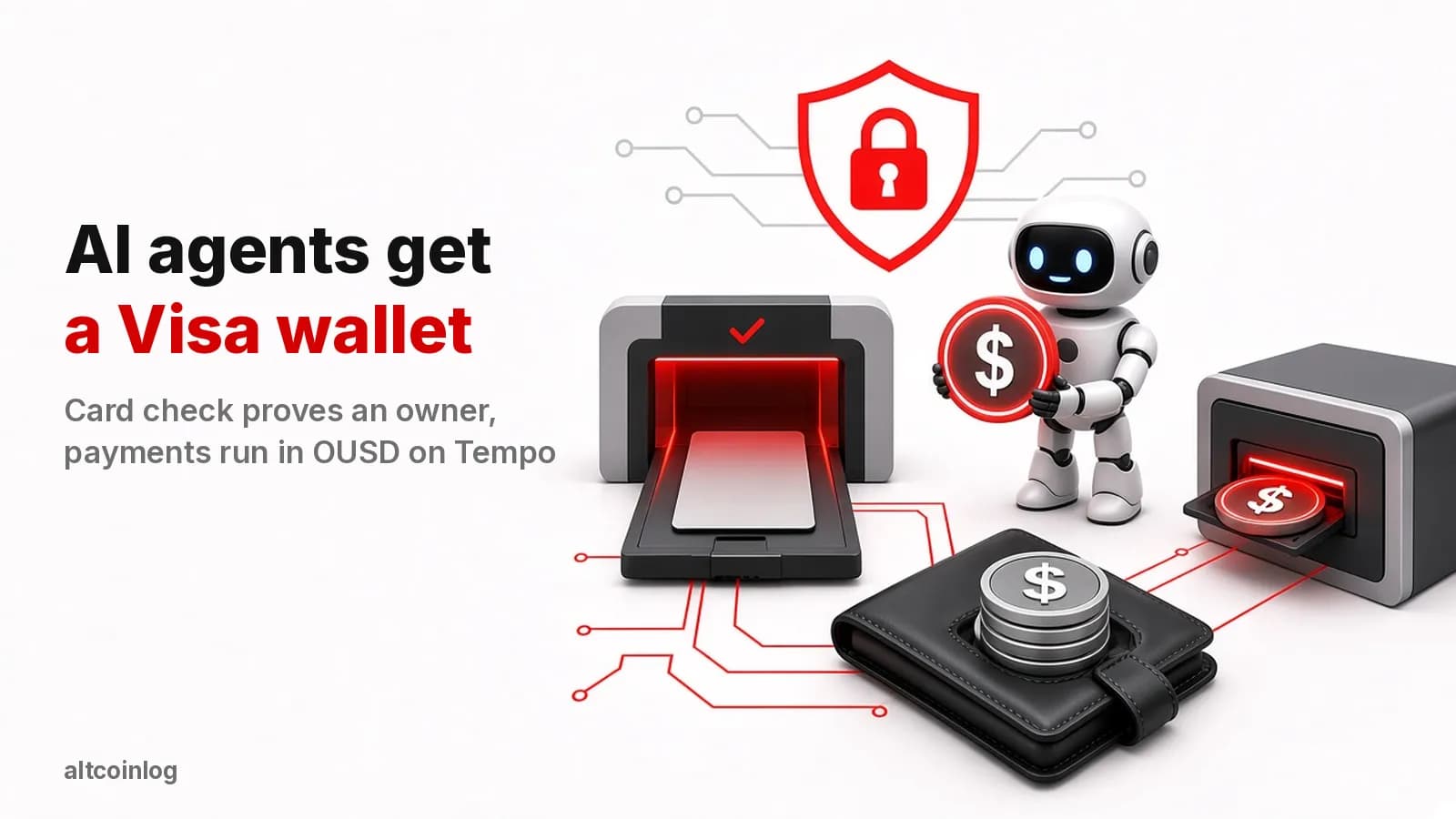
 Polly PhelonyAuthor · Blockchain
 Editor-in-ChiefEditor · checked this story
Published November 23, 2026 at 10:37 AMUpdated November 23, 2026 at 10:37 AM
Visa Crypto Labs released a new version of Visa CLI on Nov. 22, turning it into a wallet where a person verifies an AI agent with a Visa card and the agent then earns and spends OUSD, a dollar stablecoin, on the Tempo blockchain. It is open to US users with eligible cards, and accounts are approved by invitation.
Cuy Sheffield of Visa Crypto Labs announced the launch on x.com, writing that "ordinary people should be able to earn income from the AI economy." In his description, agents get paid in OUSD for completing creative tasks.
What the Visa card check proves
The card is an identity check, not a funding source. According to the Visa CLI status page on app.visacli.sh, the card step runs through VGS with a real US Visa card and a one-time code from the bank, and each card attaches to one account. Once the owner passes it, the agent receives a signing key and its requests carry an Ed25519 signature made in a secure enclave.
The keys follow the Trusted Agent Protocol (TAP), an open standard, and new agents are registered in the Visa Agent Directory. Any server can check a signature and learn that a person with a US Visa card stands behind the agent, without learning who that person is. The docs add that a pass does not mean the agent's work is good or that a given request is allowed.
Prepaid, corporate and JPMorgan Chase cards cannot be added yet. One card covers up to 25 agents, and several agents can share one wallet.
Where the money comes from and where it goes
The wallet page on app.visacli.sh is blunt about the limits. The wallet holds only OUSD on Tempo, only the owner can add money, and an agent cannot top it up. Adding a card does not charge it, and agents pay from the OUSD balance, never from the card.
Money arrives in two ways. The owner can send OUSD to the wallet address, or an agent can finish a paid task and have the reward paid into the owner's wallet. That is payment for work rather than interest on a balance, so it sits outside the current debate over rules on stablecoin rewards.
Spending happens when an agent calls an API that charges per request. Such an API answers with HTTP 402, the "payment required" status code, and a charge on Tempo. The agent pays over a payment standard called MPP, within limits the owner sets, and a request without the agent's signature is refused before anything is sent.
Visa screens withdrawal addresses and wallet payees before anything is signed. Each purchase carries its own reference, so repeating a request continues that purchase instead of paying twice. Visa reads the result from the chain and does not treat a merchant's reply as proof of payment.
A Visa product running on real money
The setup puts a card network next to the big institutions testing stablecoin payouts, with software as the payer. The status page lists the card step, task payouts and wallet balances as real, with OUSD on Tempo mainnet, so a payment moves real money. Agents connected before Nov. 18 are still registered in the sandbox version of the Visa Agent Directory, while newer ones sit in production.
This story is for information only and is not investment advice. Crypto assets are volatile and you can lose everything you put in. You decide on any trade yourself. Disclosure
Comments0
Comments are moderated. Ads, insults, and trading calls are removed. Discussion rules
No comments yet
Be the first — the author reads the thread and answers questions.