
How one trader's leaked API key froze every withdrawal on Lighter
Lighter froze withdrawals and pool creation after a leaked API key on one trader's account. Researchers put the loss near $15.5M in USDC; here is how a trading key moved funds and what API-key users can check.
All news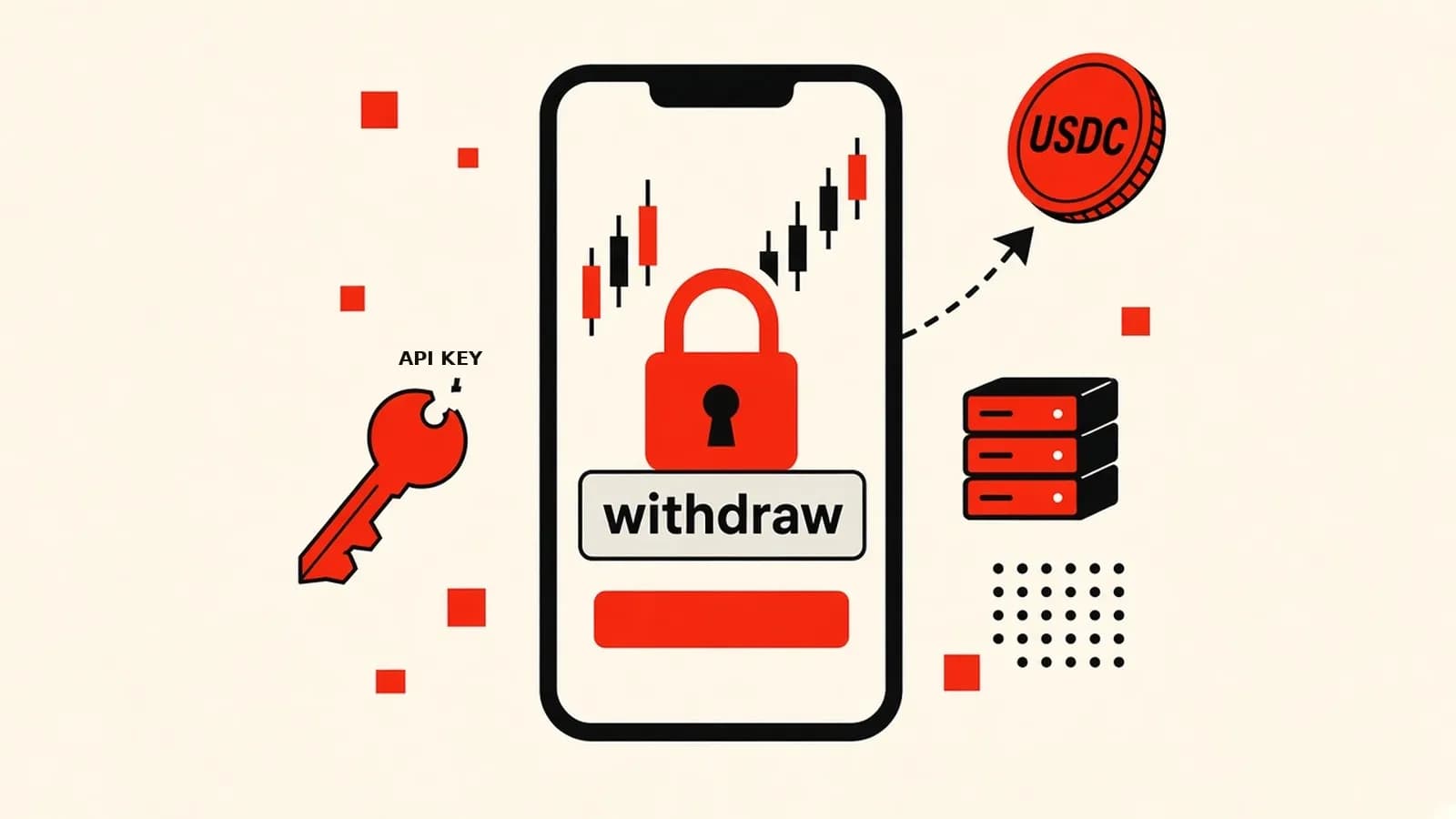
 Ilya VaynerAuthor · DeFi
 Editor-in-ChiefEditor · checked this story
Published November 17, 2026 at 06:14 AMUpdated November 17, 2026 at 06:14 AM
Lighter, a decentralized exchange for perpetual futures, suspended all withdrawals and pool creation on Nov. 16 after what it later said was a leaked API key for a single trader's account. On-chain researchers estimate that about $15.5 million in USDC left two market-maker accounts. Lighter itself has not given a figure.
In an update on X, Lighter said its protocol and smart contracts were unaffected. It switched on Guardian mode, said the Lighter Security Council would carry out a contract upgrade, and named the wallet it links to the attacker, an address starting 0xb3fff. Its stated priority is to recover funds tied to "an additional withdrawal attempt by the attacker." Lighter aimed to resume withdrawals by the end of the day; as of 16:10 UTC it had not posted that they were back.
Why a trading key could move the money
Lighter's developer documentation lists what an API key can do on its own: trade, cancel orders, change leverage, open sub-accounts, make secure withdrawals and move funds between accounts with the same owner. Secure withdrawals can only go back to the wallet that created the account. Transfers to a different owner and fast withdrawals also need a signature from that wallet. On paper, a stolen key should not be able to send money to a stranger.
The researchers' reconstruction, reported by crypto.news, describes a way around that line. The attacker allegedly closed the victims' positions, used one compromised account to create a public pool with a 0% fee, and deposited about $10,000 to own roughly 99.99% of it. Because the pool counted as the victim's own account, USDC could be moved in without a wallet signature, in batches of about $1 million, and then withdrawn by redeeming pool shares. The two accounts reportedly lost $10.39 million and $5.09 million.
That sequence would explain why Lighter froze pool creation along with withdrawals. It remains the researchers' version. Lighter has confirmed the leaked key, but not the pool mechanics, the size of the loss, how the key was exposed or whether the trader will be repaid.
What API-key users can check on any venue
API keys usually live on the servers that run trading bots, so they can leak even when an exchange's contracts hold up. Wallet operators faced a similar job this month when LNbits told them to reset every key after a run of drains, and Mercado Bitcoin kept withdrawals shut after its own security incident.
The basic checks are the same everywhere. Give each key only the permissions a strategy needs, keep withdrawal and transfer rights off where a venue allows it, bind keys to fixed IP addresses, and rotate them after any change of staff, server or software vendor. For dashboards, tax tools and AI agents that only need to read data, Lighter's documentation recommends read-only tokens instead of full API keys.
Lighter's LIT token fell more than 17% at one point on Nov. 16, according to crypto.news, and South Korean exchanges Upbit and Bithumb reportedly suspended LIT deposits and withdrawals.
This story is for information only and is not investment advice. Crypto assets are volatile and you can lose everything you put in. You decide on any trade yourself. Disclosure
Comments0
Comments are moderated. Ads, insults, and trading calls are removed. Discussion rules
No comments yet
Be the first — the author reads the thread and answers questions.