
Bitcoin miners get a 9.13% difficulty cut, the deepest since June
Bitcoin's mining difficulty fell 9.13% at block 975,744 early on Saturday, Nov. 14, from 148.36 trillion to 134.82 trillion, according to mempool.space data.
All news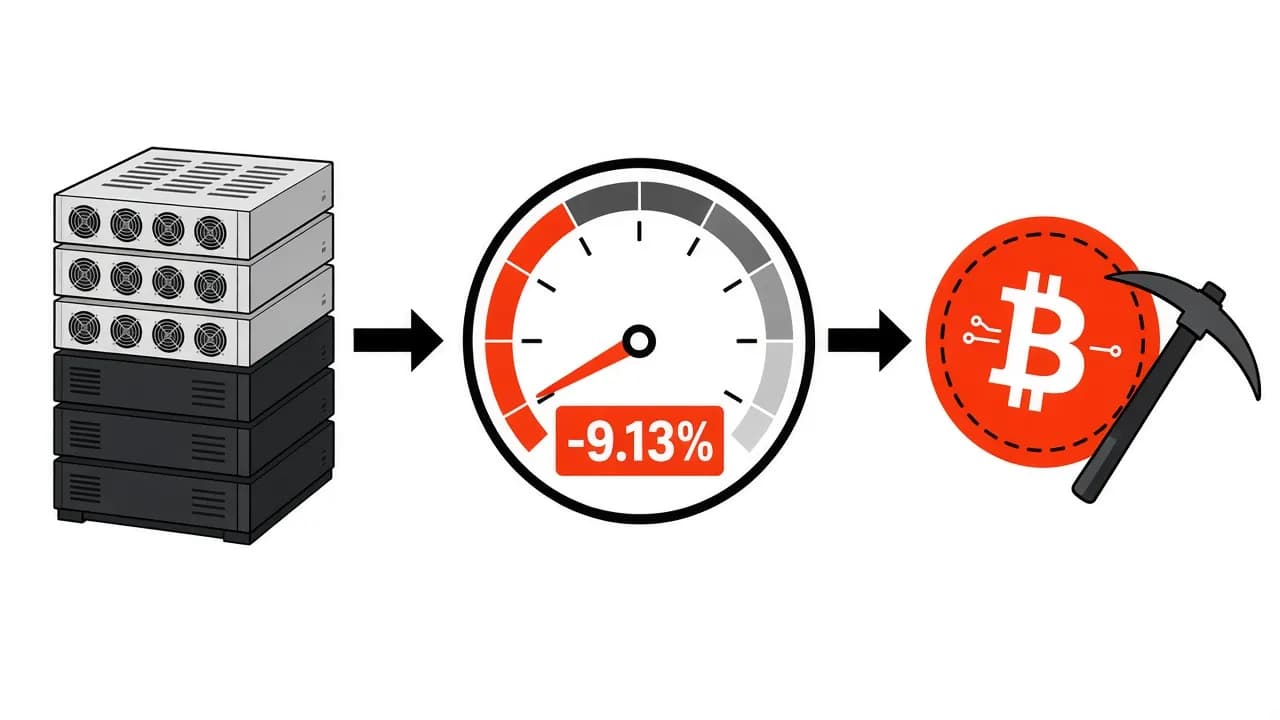
 Polly PhelonyAuthor · Mining
 Editor-in-ChiefEditor · checked this story
Published November 15, 2026 at 03:10 PMUpdated November 15, 2026 at 03:10 PM
Bitcoin's mining difficulty fell 9.13% at block 975,744 early on Saturday, Nov. 14, from 148.36 trillion to 134.82 trillion, according to mempool.space data. The cut makes each block easier to find after the network ran noticeably slow for two weeks.
Bitcoin resets difficulty every 2,016 blocks so that blocks keep arriving about every 10 minutes. The period that closed at 05:02 UTC took about 15.4 days instead of 14, or roughly 11 minutes per block. With fewer machines hashing, the protocol lowered the bar.
How Saturday's cut compares
It is the third-largest drop of 2026, behind an 11.16% cut on Feb. 7 and a 10.09% cut on June 14, per the mempool.space adjustment history. Twelve of this year's 23 adjustments have now been reductions. Saturday's move also undoes most of two straight increases, 5.92% on Oct. 16 and 5.54% on Oct. 29, which had lifted difficulty to its 2026 high. The new level sits about 13.6% below the record of 155.97 trillion set on Oct. 29, 2025.
Hashrate tells the same story, with the usual caveat that daily estimates are noisy. Mempool.space put the network at about 905 exahashes per second on Saturday. Its daily figures were above 1,000 EH/s on 10 of the 12 days from Oct. 20 to Oct. 31, and on only one day since Nov. 6.
The backdrop is price. Bitcoin traded near $65,600 at 16:05 UTC on Saturday, per the mempool.space price feed, down about 19% from roughly $80,800 when the Oct. 29 adjustment landed. The slide included a drop of about 6% in the Nasdaq-led selloff earlier this month.
What changes for hashprice
For a machine that stays online, the gain in coins is direct: the same hashrate now earns about 10% more bitcoin, since 148.36 divided by 134.82 is 1.10. In dollars the relief is thinner. By Altcoinlog's arithmetic, using the 3.125 BTC block subsidy and Saturday's price, one petahash per second would earn about $27.80 a day at the old difficulty and about $30.60 at the new one, before fees.
That lines up with Hashrate Index, which showed hashprice at $30.70 per PH/s per day at about 16:10 UTC Saturday. In its Nov. 9 weekly roundup the firm had hashprice at $31.89 and the 30-day average at $35.73, so even after the cut, revenue per unit of hashrate remains below its recent average. Members of bitcoin mining pools get the change without doing anything, since pools build new work against the lower target. Corporate treasuries face the same price from the other side: Strategy kept buying through the sell-off, adding 1,036 bitcoin in the week to Nov. 8.
The next adjustment falls at block 977,760, which mempool.space expects around Nov. 29. Its early estimate points to a further cut of about 6%, but with only 3.5% of the period mined, that number shifts with every block.
Power costs are moving against miners too. Paraguay's state utility ANDE plans to let all special electricity contracts with crypto miners expire on Dec. 31, 2027, CoinDesk reported. Miners there hold about 944 megawatts at a flat $44 per megawatt-hour, and the country accounted for about 4% of global mining power in the second quarter, according to Hashrate Index figures cited in the report.
This story is for information only and is not investment advice. Crypto assets are volatile and you can lose everything you put in. You decide on any trade yourself. Disclosure
Comments0
Comments are moderated. Ads, insults, and trading calls are removed. Discussion rules
No comments yet
Be the first — the author reads the thread and answers questions.