
Japan's FSA weighs DeFi access curbs and self-custody wallet rules
Japan's Financial Services Agency asked its expert study group on Nov. 26 whether users should be kept away from decentralized finance (DeFi) services that lack anti-money-laundering controls, and how far rules should reach into self-custody wallets. The 52-page secretariat paper is a list of discussion questions, not a draft regulation.
All news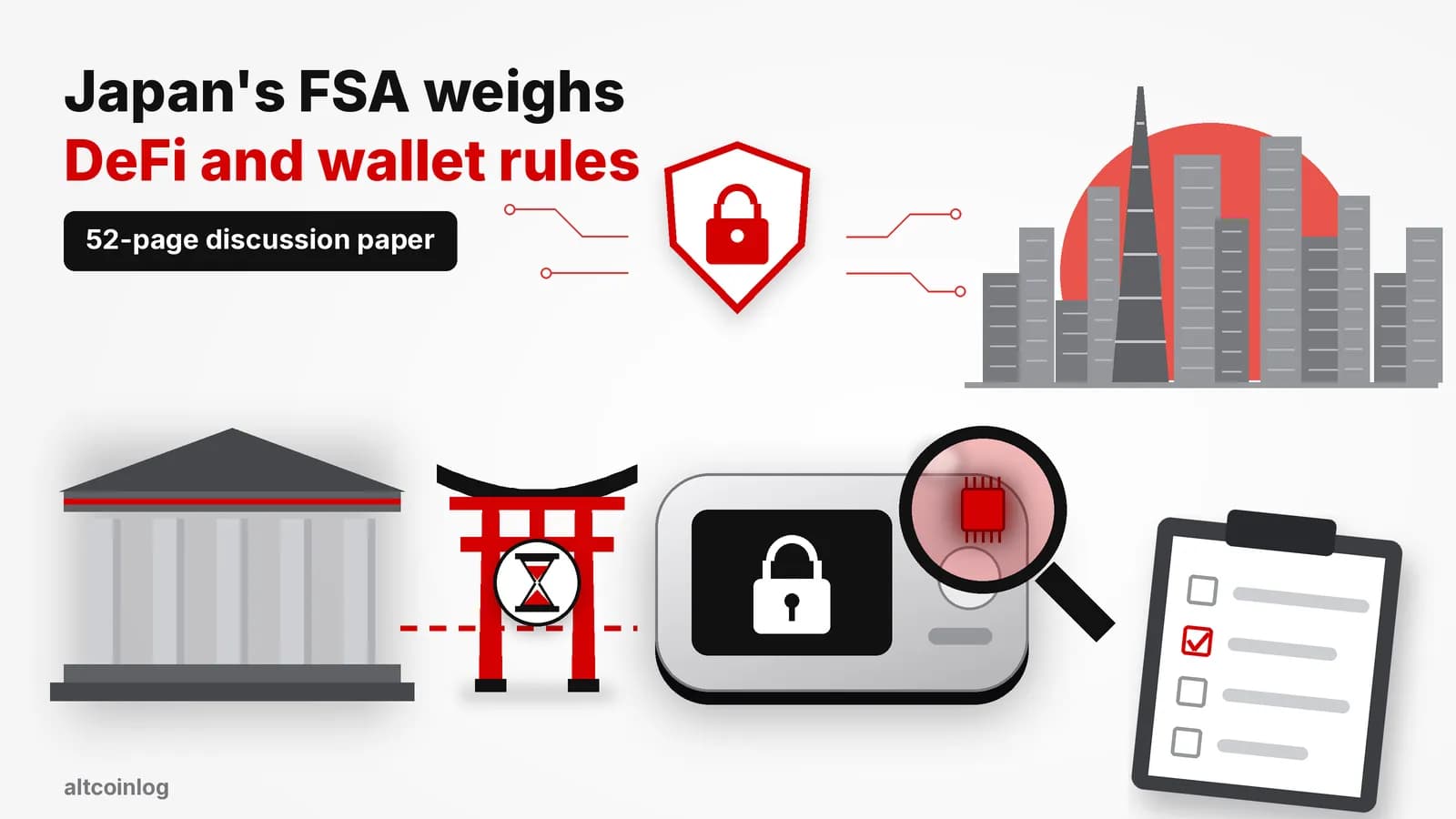
 Polly PhelonyAuthor · Investing
 Editor-in-ChiefEditor · checked this story
Published November 28, 2026 at 10:20 AM
Japan's Financial Services Agency asked its expert study group on Nov. 26 whether users should be kept away from decentralized finance (DeFi) services that lack anti-money-laundering controls, and how far rules should reach into self-custody wallets. The 52-page secretariat paper is a list of discussion questions, not a draft regulation.
It was presented at the third meeting of the Study Group on the Response to Digital and Decentralized Finance, according to the meeting agenda on fsa.go.jp.
Which parts are settled and which are only questions?
The firmest line in the secretariat paper (PDF, in Japanese) is a principle it says has international support: same function, same risk, same rules. Members are asked how to identify an accountable party when a service called decentralized is in fact centrally run, and whether, if none can be found, money-laundering controls should first run through regulated firms that touch DeFi: stablecoin issuers, on- and off-ramp providers and financial institutions. A separate question asks whether users' access to DeFi lacking AML and counter-terrorist financing controls should be deterred.
That on-ramp route resembles the French push in France wants exchanges to own the risk of DeFi access, while the EU's MiCA leaves fully decentralized services without an intermediary outside its scope, as Cointelegraph noted. On front-end providers, the paper sets the FATF view that they can fall under its standards against jurisdictions that exempt value-neutral software, and asks whether to regulate them at all. It also cites Japan's 2011 Supreme Court ruling in the Winny case, which held that releasing software usable for lawful and unlawful ends does not by itself make its developer an accomplice to users' copyright infringement.
For scale, the paper cites DefiLlama data putting DeFi total value locked at about $86.64 billion on June 10, 2026, up about 85% from May 2023, and a Coinbase and EY-Parthenon survey in which 56% of 351 institutional investors said they intend to use DeFi protocols by 2028.
What would reach exchange users first?
For self-custody, the paper notes that direct regulation of wallet use, or of providers that only develop or sell wallet software or hardware, "is not widely seen" internationally (translated from Japanese). Under Japan's anti-money-laundering law, domestic crypto firms must already keep records and collect information on transactions with unhosted wallets. Unlike the business licenses in South Korea's draft Digital Asset Act, nothing in the paper proposes licensing wallet apps.
The measure closest to users is a cooling-off period. The paper says the FSA intends to require it through a Cabinet Office ordinance to stop crypto being used as payment in investment fraud, for example by blocking transfers to an unhosted wallet right after a new exchange account is opened. The paper gives no length, scope or ordinance text. The working-group report it quotes also lists fraud warnings, transfer-purpose checks, transaction monitoring and a waiting period for transfers to new wallet addresses.
That path is common. In a March 2026 Nomura Research Institute report for Japan's Digital Agency, 812 of 3,709 crypto and NFT holders surveyed, or 21.9%, used unhosted wallets, and 59.4% of those users moved funds to and from exchanges with them.
Members are asked what could protect self-custody users who fall outside the protection Japanese law provides, and whether further anti-money-laundering measures are needed. The same report found that 38.3% of wallet users kept seed phrases or keys in notes or files on a PC or phone, including screenshots, while 7.7% used a hardware wallet. Another 15.2% said they did nothing in particular or could not remember.
This story is for information only and is not investment advice. Crypto assets are volatile and you can lose everything you put in. You decide on any trade yourself. Disclosure
Comments0
Comments are moderated. Ads, insults, and trading calls are removed. Discussion rules
No comments yet
Be the first — the author reads the thread and answers questions.