
How to Choose a Promising Altcoin: A Beginner's Guide
Learn how to evaluate altcoins by analyzing tokenomics, market cap, development activity, liquidity, real-world use and common red flags
All news

Published August 17, 2026 at 06:42 AMUpdated 12:40 PM
The cryptocurrency market contains thousands of altcoins, and new projects appear almost every week. Some become useful blockchain platforms, while others lose interest quickly or turn out to be poorly designed projects.
For a beginner, choosing an altcoin should not be based only on a rising price or a popular post on social media. A promising project needs to be evaluated from several angles, including its technology, team, tokenomics, market activity and potential use case.
What Is an Altcoin?
The term altcoin generally refers to cryptocurrencies other than Bitcoin. The category includes thousands of different projects with completely different purposes.
Some altcoins are designed to support smart contracts, others focus on payments, decentralized applications, gaming, artificial intelligence or specific blockchain infrastructure.
Because projects can be very different, there is no single formula that guarantees a coin will increase in price. The goal is to identify projects that have a reasonable combination of technology, demand and long-term potential.
Start With the Project's Purpose
The first question to ask is simple: What problem does this project actually solve?
A cryptocurrency with a clear use case is usually easier to evaluate than a token created only because a particular trend is popular.
Look at the project's website and documentation. Try to understand what the blockchain or token is designed to do and why users would need it.
Tip: if you cannot explain the project's purpose in a few simple sentences, take more time to research it before investing.

Check the Team and Development Activity
The people building a project can tell you a lot about its credibility. Check whether the team members are publicly known, what experience they have and whether they have worked on relevant projects before.
Development activity is another useful indicator. An active GitHub repository, regular updates and visible technical progress can show that a project is still being developed.
However, an active GitHub page alone does not guarantee success. It should be considered together with other factors.
Study Market Capitalization
Many beginners look only at the price of a coin. This can be misleading.
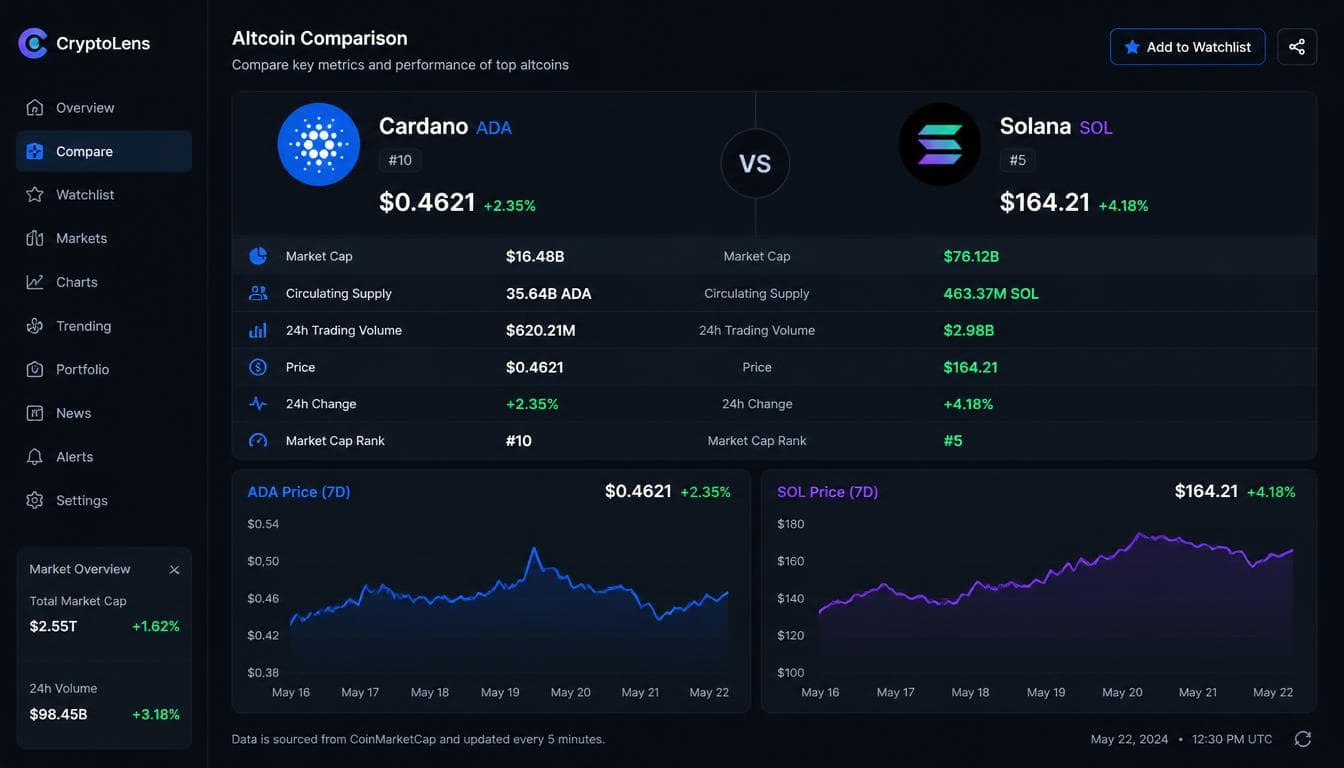
A token priced at $0.10 is not necessarily cheaper than one priced at $100. What matters is the market capitalization, which reflects the total market value of the circulating supply.
For example, a project with a huge number of tokens can have a very low individual price while already having a large market capitalization.
When comparing projects, look at:
- Current market capitalization
- Circulating supply
- Total supply
- Maximum supply
- Trading volume
- Fully diluted valuation
Understand Tokenomics
Tokenomics describes how a cryptocurrency's supply and distribution work.
Before investing, find out how many tokens currently exist, how many will be released in the future and who controls a large portion of the supply.
Pay particular attention to token unlocks. If a large number of tokens are scheduled to enter circulation, selling pressure can increase.
Also check how tokens are distributed between the team, investors, community and ecosystem.
Important: a strong project can still have an unattractive token if its supply is poorly designed or heavily concentrated among a small number of holders.
Look at Real Usage
A project can have impressive marketing and thousands of followers, but that does not necessarily mean people actually use it.
Check whether the blockchain has active users, applications, transactions, developers or other measurable activity.
Depending on the project, useful metrics can include:
- Daily active addresses
- Transaction volume
- Total Value Locked (TVL)
- Number of applications
- Developer activity
- Protocol revenue
These numbers should not be considered in isolation, but they can help distinguish a functioning ecosystem from a project that mainly relies on hype.
Check Liquidity and Trading Volume
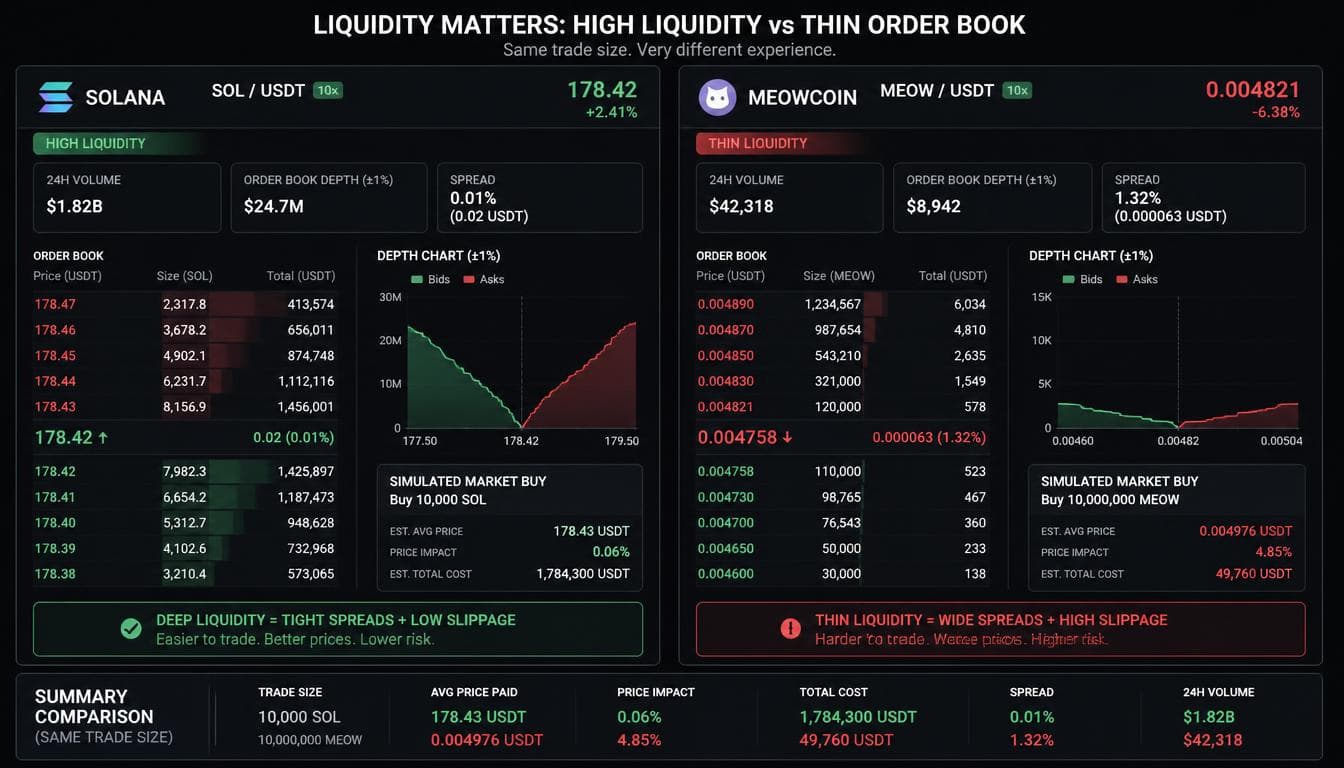
Liquidity is especially important if you plan to buy or sell an altcoin.
A token with very low trading volume can be difficult to sell without significantly affecting its price. Large spreads and low liquidity can also make transactions more expensive than expected.
Before buying, check where the token is traded, its daily volume and the depth of the market.
Do Not Ignore Community and Hype
A strong community can help a project grow, but social media popularity should not be confused with fundamental value.
Thousands of followers can be created through advertising, giveaways or artificial engagement. Look at how people actually discuss the project and whether developers regularly communicate with the community.
Social media should be a source of information, not your main reason for buying a coin.
Red Flags to Watch For
Some warning signs deserve additional attention:
- Promises of guaranteed returns
- Anonymous or unverifiable team members
- Extremely concentrated token ownership
- Unclear tokenomics
- Very low liquidity
- No meaningful product or development
- Aggressive marketing focused only on price
- Pressure to invest immediately
- Unusually high guaranteed yields
One red flag does not automatically prove that a project is a scam, but several of them together should make you extremely cautious.
A Simple Checklist for Beginners
Before buying an altcoin, ask yourself:
- What problem does the project solve?
- Does the token have a real purpose?
- Who is developing the project?
- How active is development?
- What is the market capitalization?
- How are the tokens distributed?
- Are large token unlocks coming?
- Does the project have real users and activity?
- Is there enough liquidity?
- What could make the project fail?
If you cannot answer most of these questions, it is probably too early to invest.
Final Thoughts
There is no reliable method for predicting which altcoin will become the next major cryptocurrency. A good project can still lose value because of market conditions, competition or problems within its ecosystem.
The best approach is to treat every altcoin as a research project rather than a quick opportunity to make money. Look beyond the price chart, study the fundamentals and never invest more than you can afford to lose.
This story is for information only and is not investment advice. Crypto assets are volatile and you can lose everything you put in. You decide on any trade yourself. Disclosure
Comments0
Comments are moderated. Ads, insults, and trading calls are removed. Discussion rules
No comments yet
Be the first — the author reads the thread and answers questions.