
What Is Ethereum Staking? How It Works and How Many ETH You Need (2025 Guide)
Today we’ll take a closer look at how to stake Ethereum and walk through the process step by step. Ethereum’s creator, Vitalik Buterin, has long argued against relying on miners. He believes that…
All news

Published September 25, 2025 at 01:58 PMUpdated 08:28 PM
Today we’ll take a closer look at how to stake Ethereum and walk through the process step by step. Ethereum’s creator, Vitalik Buterin, has long argued against relying on miners. He believes that proof-of-work (PoW) ultimately puts too much control in the hands of large mining farms, which weakens decentralization across blockchains. On top of that, the massive energy consumption of Bitcoin and other PoW networks has become a frequent target of criticism, especially in light of today’s global energy concerns.
As crypto goes mainstream and aims to establish itself as a legitimate, useful technology, scalability and energy consumption have become critical issues.
In December 2021 Ethereum launched a test PoS chain, and by the fall of the following year it fully phased out miners.
What is staking in Ethereum 2.0?
With Ethereum 2.0 staking, you lock up ETH in a special smart contract to become a validator. Validators take on a similar role to miners: they confirm transactions and help produce blocks. The difference is that they do it with far lower energy costs. This is the essence of what staking Ethereum means.
The locked ETH acts as a safety deposit. It guarantees that validators won’t harm the network, because if they break the rules, their own funds are at risk. To run your own validator, you need a minimum of 32 ETH. At today’s rate, that’s about $50,000 USD – a serious investment. So if you’re asking how many ETH to stake or what is stake ETH, the answer starts at 32 ETH for solo validators.
You can also join an ETH staking pool or stake through a DeFi platform.
How to participate in ETH staking?

Well-funded investors, or even experienced miners with enough capital, can set up their own validator node. Another option is to join a staking service or pool. These platforms let you stake any amount of ETH without running the hardware yourself. But keep in mind, using a third party has risks: if the validator you support is penalized or turns out to be a scam, you share the losses.
For those determined to go solo, here’s the setup overview.
Spinning up a node: hardware and recommendations
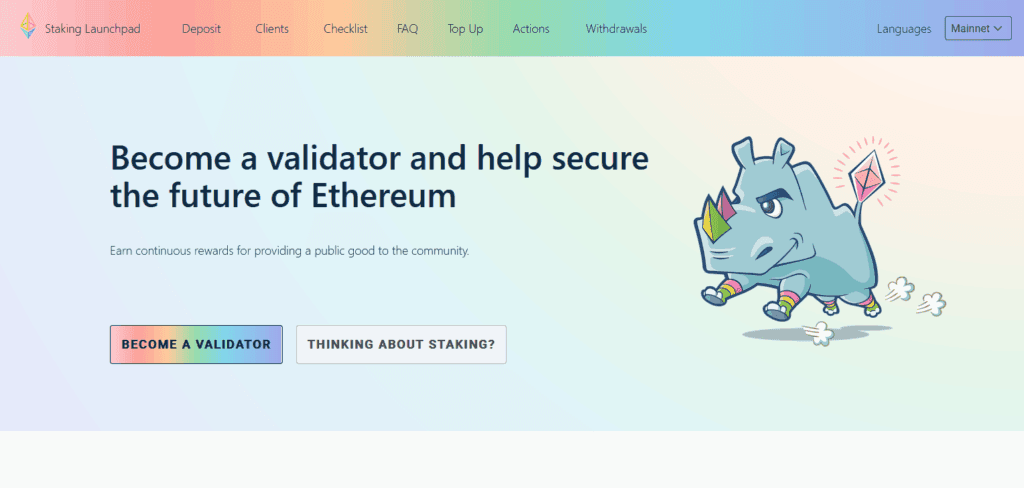
To start staking ETH, complete the following steps:
- https://launchpad.ethereum.org
- If you’re not fully familiar with proof-of-stake mechanics, carefully read the next page, then click “Continue.”
- Confirm you understand that the Beacon Chain deposit is one-way and irreversible, and that you are voluntarily sending 32 ETH to become a validator.
- Confirm you have sufficient skills to run a node.
- Accept the reward payout terms.
- Agree to the penalties for malicious or negligent behavior.
- Acknowledge the key management requirements.
- Accept the validator commitments and the risks associated with connecting during early/test phases.
- Review the staking checklist you’ll use as a guide and click “I accept.”
- Confirm you agree to all service terms and proceed to node configuration.
Choose and configure an ETH1 (execution) client
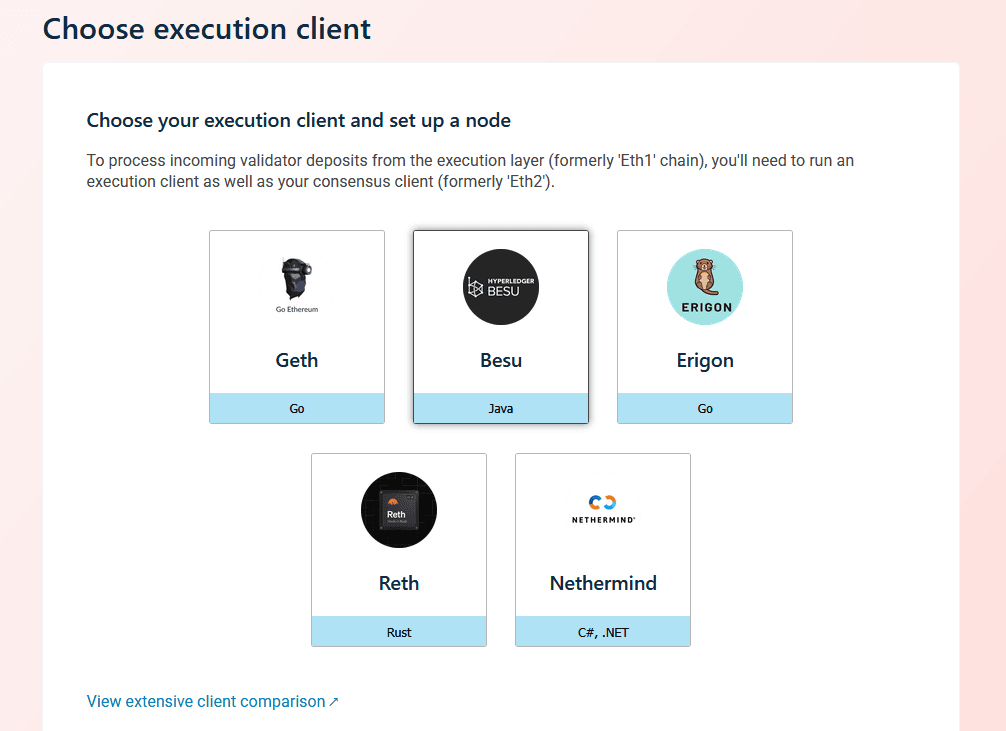
Pick one of the five Ethereum execution clients and follow its documentation:
- Nethermind — .NET core–based
- Besu — Java
- Geth — Go
- Reth — Rust
- Erigon — Go
Each client’s page includes technical docs and a detailed runbook.
Choose and configure an ETH2 (consensus) client
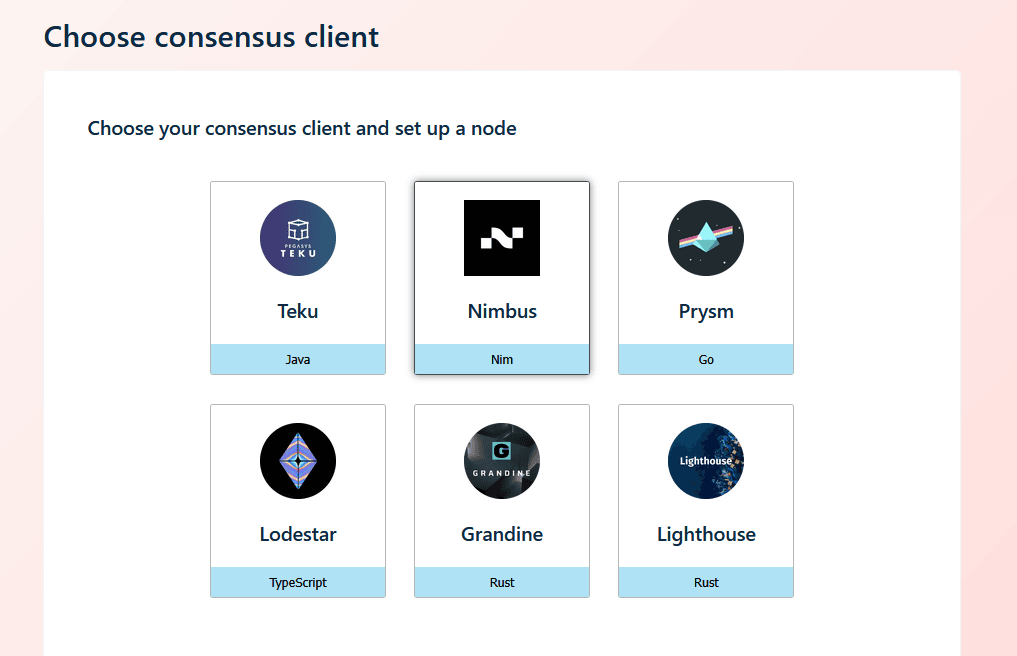
Then select a consensus client:
- Prysm — Go
- Nimbus — Nim
- Lighthouse — Rust
- Teku — Java
- Lodestar — TypeScript
Every client has its nuances—choose based on your stack and operational preferences.
Two Types of Staking Accounts
There are two staking account options available:
- With compound interest (recommended for most users).
- With regular withdrawals.
In both cases, you need to have at least 32 ETH on your balance. Detailed information about different node types is available at: Ethereum Launchpad FAQ
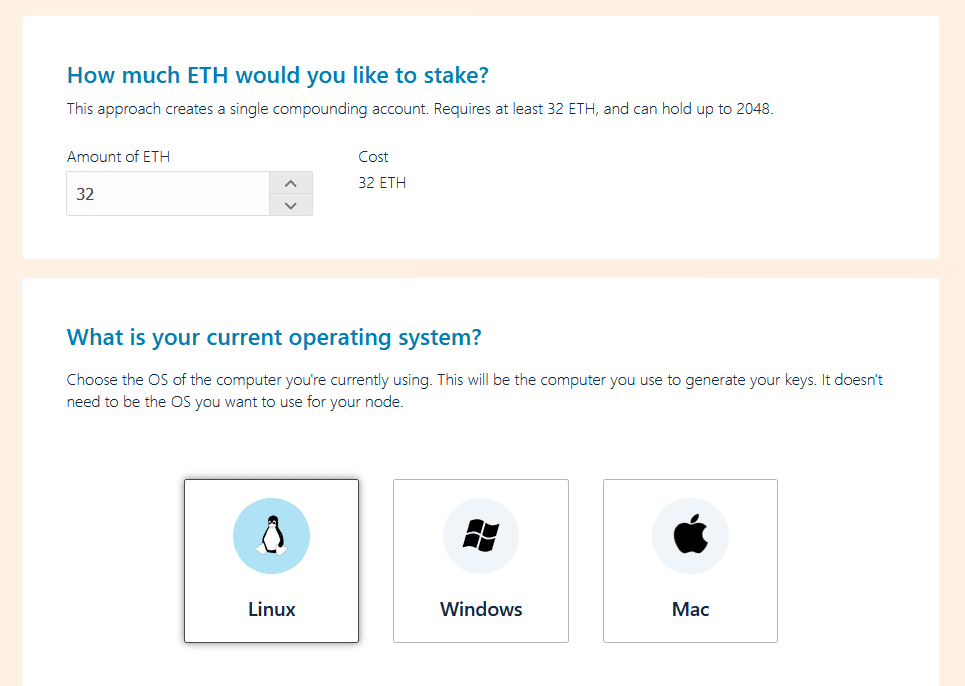
Next, you’ll need to specify how many nodes you plan to run, the operating system, and the terminal launch method. Then, following the instructions, generate a key pair and upload the validator_keys file. Fund your wallet and upload the deposit_data.json file. To continue, confirm that you’ve saved your keys and mnemonic phrase.
After funding your wallet and completing the deposit, your node will go live and start validating transactions. That’s the technical side of how to stake ETH.
Hardware requirements:
- At least 32 GB of RAM (64 GB recommended).
- Network bandwidth of at least 10 Mbps.
- Recommended storage: 4 TB HDD/SSD.
- Buy a UPS (uninterruptible power supply) to protect against brief power outages.
Staking ETH on Bybit
If you can’t deposit 32 ETH or set up a validator node, you can still participate via liquid staking pools, such as those offered on Bybit. Here’s how to do it.
Creating an Account and Buying ETH
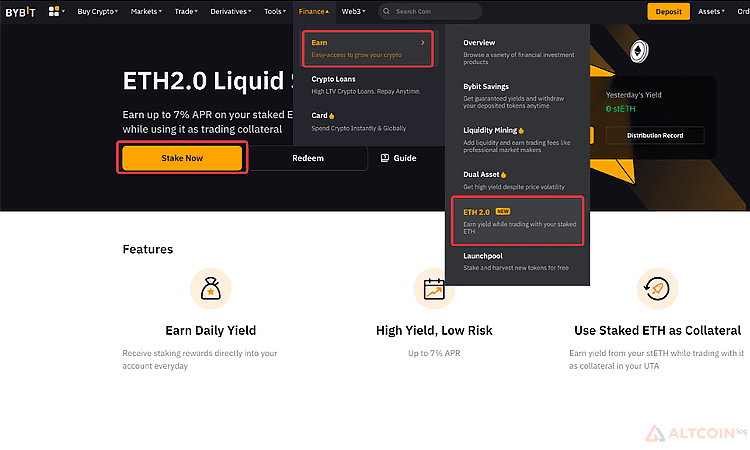
- Bybit Registration
- Enter your email or phone number and create a password.
- Click “Create Account” and confirm with the verification code sent to your email/phone.
- Complete identity verification (KYC): Provide personal info.
- Upload an ID (passport, ID card, or driver’s license) and a selfie.
- For KYC level 2, you’ll need to pass a dynamic facial verification.
- Address confirmation is optional at this stage.
Once your KYC is approved, you can access all Bybit services, including ETH staking.
Funding Your Account
- Minimum deposit: 0.001 ETH.
- You can transfer ETH from your personal wallet or buy ETH directly on Bybit using fiat or another cryptocurrency.
- If using fiat (e.g., RUB), first convert it to USDT on the spot market, then exchange it for ETH.
Starting ETH 2.0 Staking on Bybit
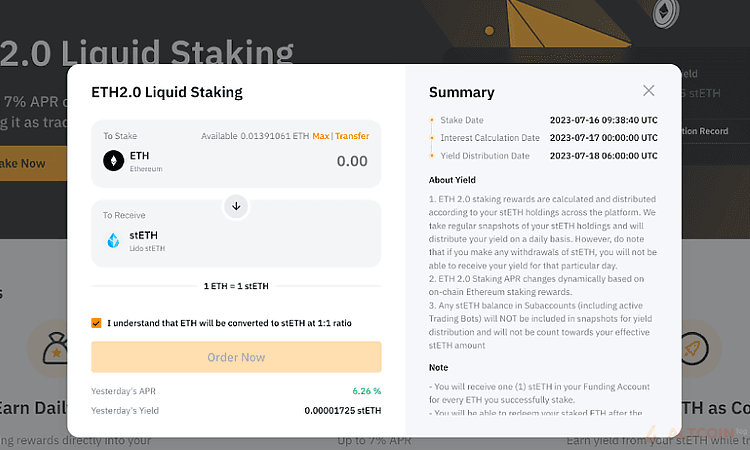
- Go to Bybit Earn → ETH 2.0.
- Click Start.
- Enter the amount of ETH you want to stake.
- Tick the checkbox to accept the conversion of ETH to stETH.
- Click Order.
- Read the pop-up warning and confirm your decision.
Your ETH will be locked into staking, and you’ll receive stETH tokens in return. These represent your funds:
- You can spend or withdraw them, but then you won’t receive staking rewards.
- The best option is to keep them in your spot wallet for trading while earning rewards.
Detailed instructions: Bybit ETH 2.0 Liquid Staking Guide
Profitability
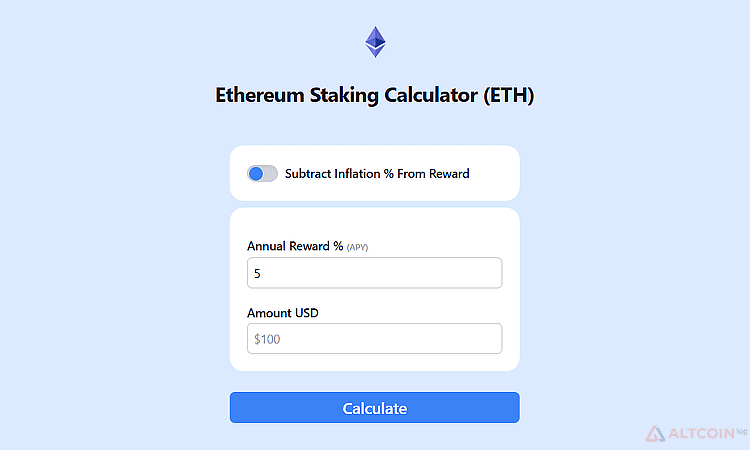
Your profit will depend on how dynamically the new network develops and, of course, on the amount of funds you invest. An Ethereum staking calculator is available at: ETH Staking Calculator
Advantages | Risks |
The system becomes faster and more eco-friendly | Strict penalty system |
Every ETH holder can earn through collective staking pools | |
Increased reliability and security | |
Reduced risk of losing decentralization |
Conclusion
Many in the blockchain community were unhappy about Ethereum’s transition to Proof of Stake (PoS) – understandable, since the coin used to provide steady income to thousands of miners. But everything changes. Humanity is gradually exhausting its energy resources, and maintaining the constant operation of hundreds of thousands of GPUs and ASIC miners is becoming increasingly expensive.
In the future, almost all cryptocurrencies will likely adopt Proof of Stake, while PoW miners will slowly disappear. It’s unfortunate, but inevitable. Many believe that Ethereum staking is only the beginning, and that most blockchains will eventually adopt Proof of Stake. Mining won’t vanish overnight, but its decline is already clear.
Subscribe to our Telegram channel and read the comments, where smart people sometimes write smart things.
This story is for information only and is not investment advice. Crypto assets are volatile and you can lose everything you put in. You decide on any trade yourself. Disclosure
Comments0
Comments are moderated. Ads, insults, and trading calls are removed. Discussion rules
No comments yet
Be the first — the author reads the thread and answers questions.