
Custodia's Supreme Court loss leaves crypto banks one way into the Fed
The US Supreme Court declined to hear Custodia Bank's case, ending its six-year push for a Federal Reserve master account and leaving access decisions to Reserve Banks.
All news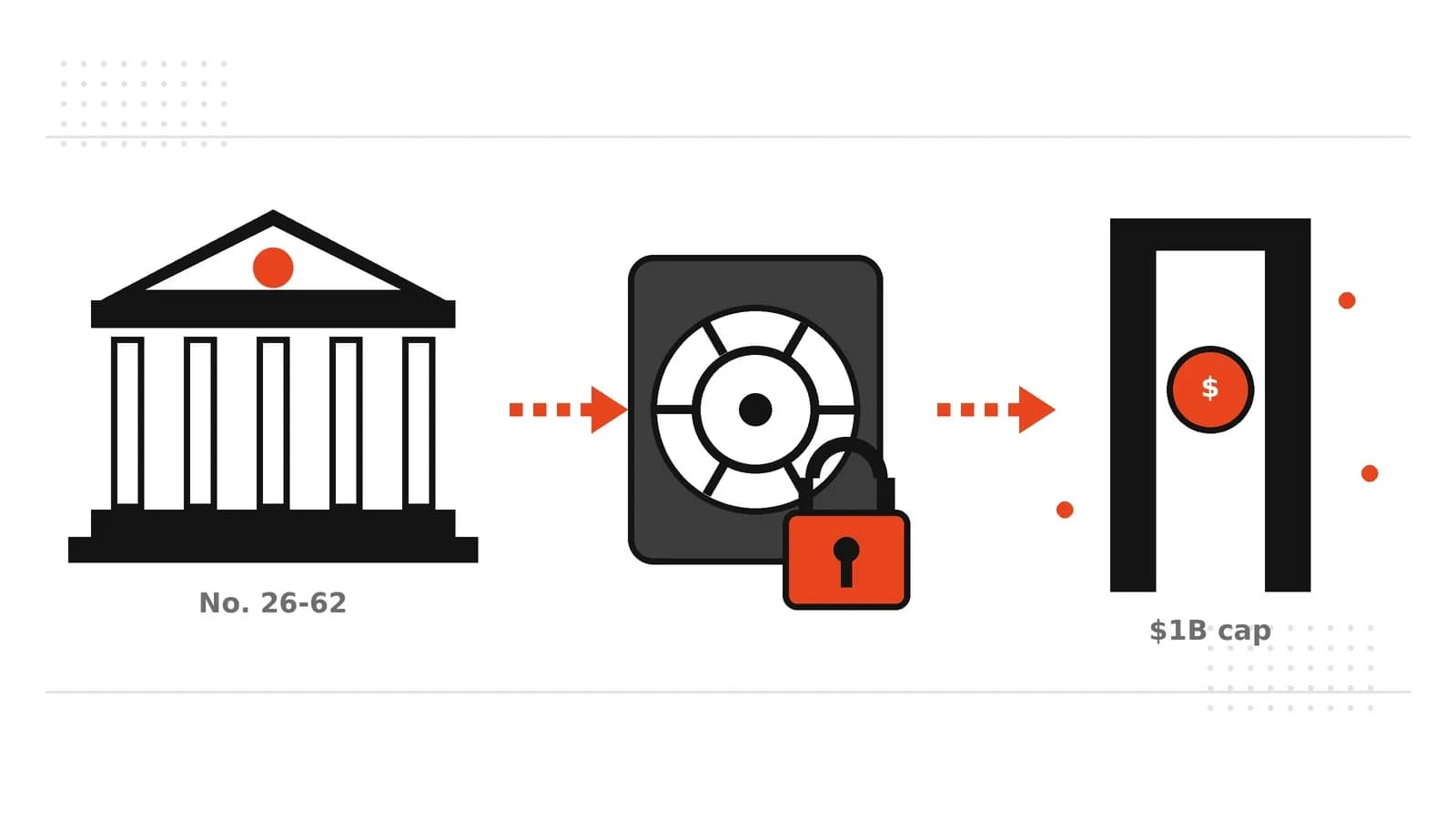
 Ilya VaynerAuthor · New
 Editor-in-ChiefEditor · checked this story
Published November 17, 2026 at 10:57 AMUpdated November 17, 2026 at 10:57 AM
The US Supreme Court on Monday, Nov. 16, declined to hear Custodia Bank's case against the Federal Reserve, ending the Wyoming crypto bank's six-year push for a master account. The docket for No. 26-62 now reads "Petition DENIED," which leaves in place an October 2025 Tenth Circuit ruling that Reserve Banks may refuse an account even to a legally eligible institution.
A denial of certiorari is not a ruling on the merits. It still matters: the appeals court's reading now binds federal courts in the six Tenth Circuit states, Wyoming included, and Custodia's court fight is effectively over. The petition had drawn amicus briefs from the Blockchain Association, The Digital Chamber, and Senator Cynthia Lummis with former Senator Patrick Toomey before it was distributed for the justices' Nov. 13 conference.
Same charter, same Reserve Bank, different answer
Custodia, founded by Caitlin Long, applied to the Kansas City Fed in 2020 and was turned down in January 2023. Kraken Financial holds the same Wyoming special purpose depository institution charter and went to the same Reserve Bank. On March 4 the Kansas City Fed approved a limited purpose account for it, classed it as Tier 3 and set an initial term of one year.
Kraken's own blog called the result a master account. The Kansas City Fed described something narrower in a May 8 note: Kraken Financial can use only the Fedwire Funds Service, gets no intraday or discount window credit, faces a closing balance limit and earns no interest. The Kraken exchange and other Payward units got no access at all.
That gap is how the Tenth Circuit rule works in practice. Legal eligibility gets a bank an application. The Reserve Bank decides whether it gets an account, and on what terms.
The payment account becomes the main route
Kraken's terms follow a template the Fed Board has been drafting since December 2025, and the Board now wants it to be a standard product. Its May 20 payment account proposal describes accounts with no Fed credit, no interest and automated overdraft controls. Each holder would get a closing balance limit based on its expected payments, capped at $1 billion. The December 2025 prototype had floated the lesser of $500 million or 10% of total assets.
The same proposal asks Reserve Banks to pause decisions on Tier 3 requests, the group Kraken Financial falls into, until the Board finishes the policy. Comments closed on July 27, and the Board has not announced a final version.
Firms left outside the Fed keep relying on a partner bank that holds its own master account, and that bank can drop crypto clients on its own schedule. Access through intermediaries can also vanish by government order, as FinCEN showed on Nov. 6 when it cut MEXC off from US fund rails, although that was an enforcement action against an offshore exchange.
Coinbase won final approval for its OCC national trust charter this month. The Fed's proposal says "would not expand or otherwise change legal eligibility," and by law each account request, whatever the charter behind it, is decided by a Reserve Bank.
This story is for information only and is not investment advice. Crypto assets are volatile and you can lose everything you put in. You decide on any trade yourself. Disclosure
Comments0
Comments are moderated. Ads, insults, and trading calls are removed. Discussion rules
No comments yet
Be the first — the author reads the thread and answers questions.