
Bitcoin, ether and stablecoins can count toward CFTC exchange reserves
CFTC staff said on Nov. 23 that swap execution facilities (SEFs), designated contract markets (DCMs) and derivatives clearing organizations (DCOs) may count bitcoin, ether and payment stablecoins toward the financial resources they must hold to cover a year of operating costs, after haircuts. The same assets cannot fill the cash-like slice of that buffer.
All news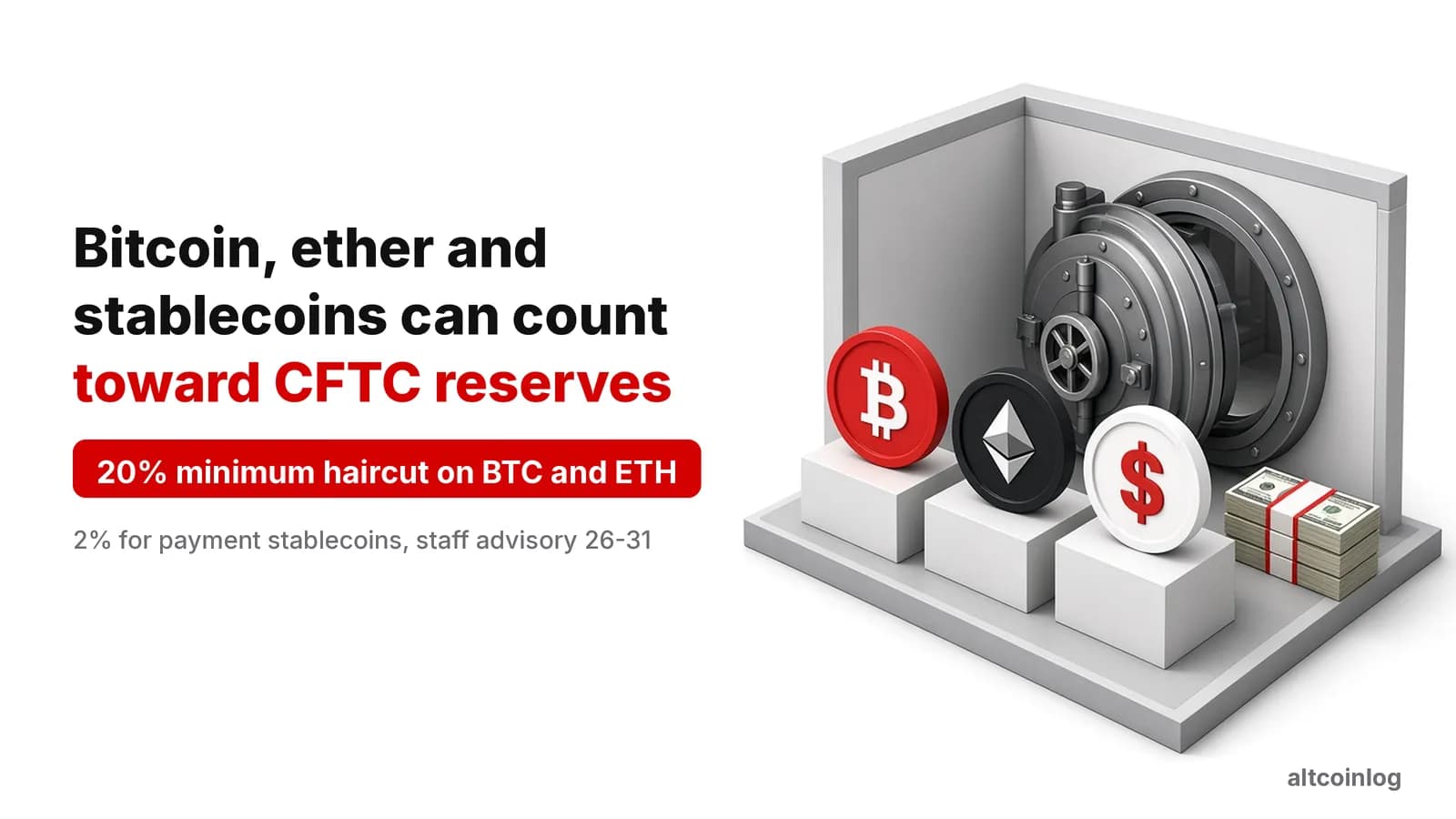
 Polly PhelonyAuthor · Investing
 Editor-in-ChiefEditor · checked this story
Published November 24, 2026 at 08:33 AMUpdated November 24, 2026 at 08:33 AM
The views come in CFTC staff advisory 26-31, issued by the Division of Market Oversight and the Division of Clearing and Risk. It covers Regulations 37.1301 for SEFs, 38.1101(a) for DCMs and 39.11(a)(2) for DCOs. According to the letter, several registered entities and applicants already hold crypto and asked whether it counts.
How much of a bitcoin or ether holding counts?
Each venue must keep financial resources that exceed its operating costs for one year, calculated on a rolling basis. Staff say bitcoin, ether and payment stablecoins may serve as acceptable resources, valued at current market value minus haircuts. They would not object to the haircuts already accepted for futures commission merchants' own crypto positions: a minimum of 20% for bitcoin and ether and 2% for payment stablecoins.
On those numbers, $1 million of bitcoin would count for no more than $800,000, and $1 million of a qualifying stablecoin for $980,000. A token that is not readily marketable and is not a payment stablecoin would generally take a 100% haircut, so it counts for nothing. Venues that want to use other crypto assets are told to engage with staff first.
The letter defines a payment stablecoin in two stages. Before the GENIUS Act takes effect, it is a dollar token issued by a state-regulated money transmitter, a state-regulated trust company or a national trust bank, backed only by cash, Treasuries or overnight Treasury repos, with monthly reserve attestations. After that date, it must meet the GENIUS Act definition and come from a permitted issuer or a compliant foreign issuer. That is the law behind the OCC rule on stablecoin rewards.
Staff also ask venues to weigh wrong-way risk, such as operating losses arriving at the same time as falling crypto prices.
Is this a new CFTC rule?
No. The CFTC press release says the advisory represents staff views only, creates no new rules or enforceable rights and is not a no-action position. It also does not necessarily reflect the views of the Commission. That makes it lighter than the CFTC's Nov. 5 guidance on DCM access, which the Commission issued in its own name.
The letter deals with a venue's own operating-cost buffer. Margin collateral was handled separately in a December 2025 staff no-action letter, and the advisory does not address a DCO's default resources under Regulation 39.11(a)(1). It applies to crypto-native operators as well, such as Backpack, whose CFTC exchange and clearing approval gave it both a DCM and a DCO.
Why can't crypto meet the liquidity requirement?
Part of the one-year buffer must sit in "unencumbered, liquid financial assets (i.e., cash and/or highly liquid securities)." Staff say crypto, including payment stablecoins, does not qualify as cash for GAAP reporting purposes and is not a highly liquid security, because these are non-security crypto assets.
For a SEF, the liquid slice is at least three months of projected operating costs, or the projected wind-down costs if those are higher. For DCMs and DCOs, it is at least six months. A DCM or DCO relying on the advisory can therefore use bitcoin, ether or stablecoins for no more than half of the one-year requirement.
This story is for information only and is not investment advice. Crypto assets are volatile and you can lose everything you put in. You decide on any trade yourself. Disclosure
Comments0
Comments are moderated. Ads, insults, and trading calls are removed. Discussion rules
No comments yet
Be the first — the author reads the thread and answers questions.