
Forged BGP routes hijacked hashrate at over 1,000 bitcoin mining sites
Attackers used forged internet routes to hijack unencrypted Stratum V1 connections between bitcoin miners and their pools this month, Braiins said on Nov. 25. On Nov. 20 more than 1,000 mining sites lost their pool connection in the same second, and a single episode diverted up to 1.9 EH/s.
All news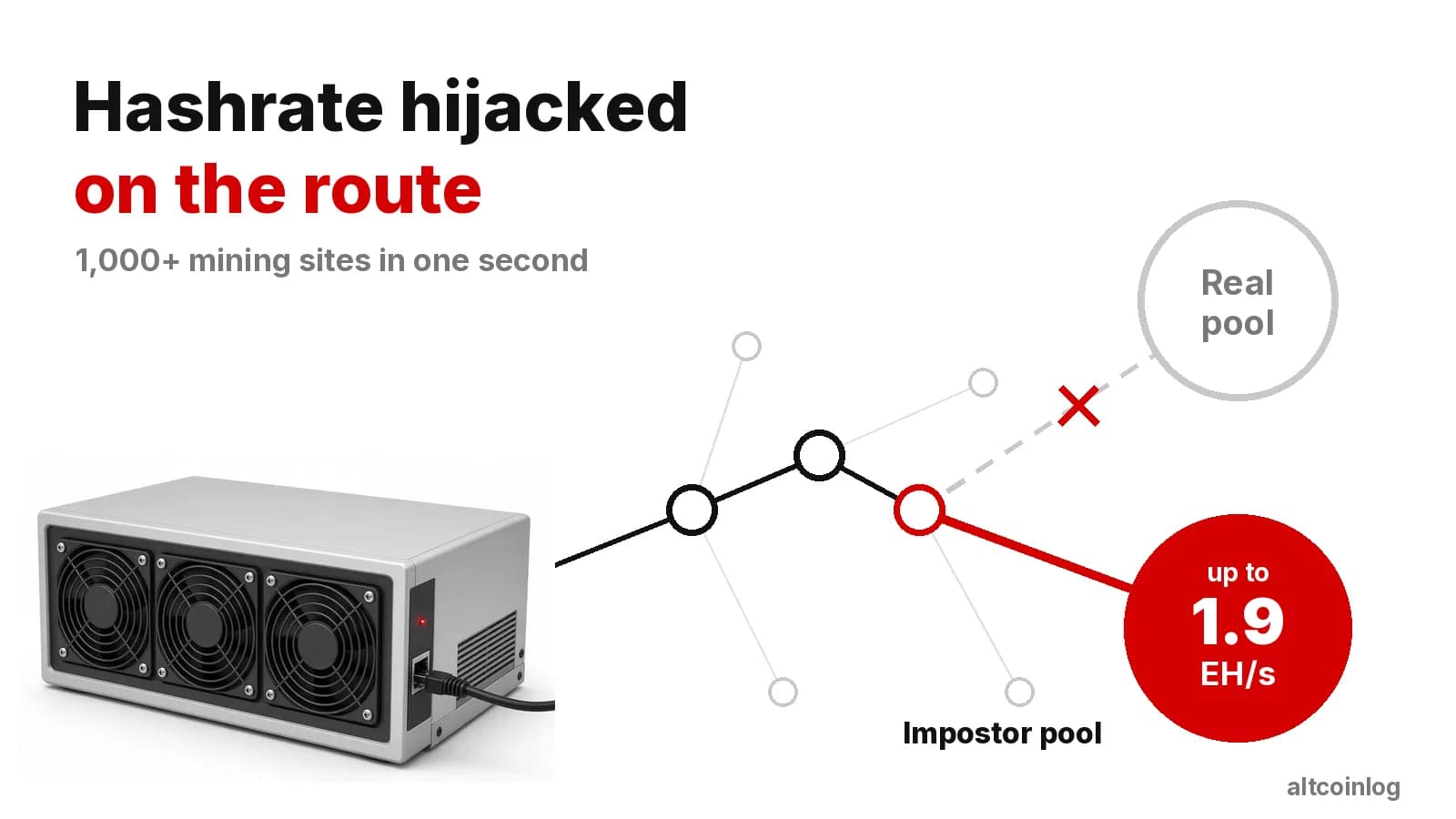
 Polly PhelonyAuthor · Mining
 Editor-in-ChiefEditor · checked this story
Published November 26, 2026 at 08:16 AMUpdated November 26, 2026 at 08:16 AM
Braiins says neither its pool nor the miners' machines were breached. The attacker sat on the network path between them, posed as the pool and kept the work. The company laid out logs and a packet capture from affected sites in a security alert on braiins.com.
How did the attack work?
It relied on BGP, the protocol networks use to tell each other which IP addresses they can reach. On Nov. 20 the pool's provider announced a block of 4,096 addresses. Someone announced a smaller block of 256 addresses that contained the pool's Stratum address, and routers follow the more specific route, so traffic from many networks went to the attacker.
Affected miners received a TCP reset, reconnected within a second to the same hostname and IP address, and reached a different server. It accepted any username and password, relayed real jobs from another large public pool and raised share difficulty in steps, up to 2,147,483,640 in one log. Braiins Pool never sets difficulty above 16,777,216.
The first wave hit Latin America, mostly Brazil and Argentina, from Nov. 7 to 12: 19 episodes of 120 to 400 sites and 36 to 174 PH/s. The Nov. 20 wave was mostly in Europe, with four episodes lasting 6 to 49 minutes and covering 1,050 to 1,600 sites each.
Why can't Stratum V1 spot an impostor pool?
Stratum V1 sends everything in plain text and gives a miner no way to verify the server, which has been true since the protocol appeared in 2012. The trick is old. In 2014 Dell SecureWorks researchers documented a hijacker on sophos.com who redirected miners through 51 compromised networks at 19 ISPs and earned an estimated $83,000 in slightly more than four months.
On site nothing looks wrong. The machine reports normal hashrate, normal temperature and a live pool, and the loss shows up only on the pool dashboard. Backup URLs that resolve to the same address do not help. The weakness applies to any pool that accepts plain Stratum V1, which now belongs on the list when choosing a mining pool. The Nov. 20 wave came six days after this month's 9.13% difficulty cut.
What protects miners and network operators?
Stratum V2 encrypts and authenticates the session: its specification makes the handshake mandatory for remote upstream connections, and a miner drops a server that cannot prove it holds the pool's key. Stratum V1 over TLS is a stop-gap that works only if the firmware checks the certificate. Braiins tested seven firmware implementations, and two other widely used ones accepted invalid certificates.
For ASIC miners whose firmware supports neither option, Braiins released a free proxy that talks Stratum V2 to the pool from inside the local network. Its basic rule is that no pool entry, backups included, should start with stratum+tcp://.
Networks that validate routes with RPKI rejected the Nov. 20 announcement, so the forged route reached only miners behind networks that do not check. The provider blocked the network that spread it that evening. Public routing data shows similar announcements for address blocks holding Stratum endpoints of other large pools, and some of them were still receiving forged routes on Nov. 22.
This story is for information only and is not investment advice. Crypto assets are volatile and you can lose everything you put in. You decide on any trade yourself. Disclosure
Comments0
Comments are moderated. Ads, insults, and trading calls are removed. Discussion rules
No comments yet
Be the first — the author reads the thread and answers questions.